Discover the Beauty Intelligence Report
A comprehensive analysis of platforms, creator dynamics, and market shifts shaping the global beauty ecosystem.
Download reportOverview
Navigating social media as a beauty brand right now feels like trying to hit a moving target. Just when you think you’ve mastered the algorithm, the goalposts shift.
To help make sense of the noise, our insights team at Lefty analyzed 250,000 influencers tracking 500 beauty brands across eleven distinct categories spanning everything from Masstige and Luxury to Dermacosmetics, Celebrity brands, and Beauty Tech. The data reveals that the global beauty industry generated a staggering $33.4 billion in Earned Media Value (EMV) across Instagram, TikTok, YouTube, and Weibo in 2025.
But beneath that massive number lies a much calmer truth: year-on-year growth slowed to a modest 5% and audience attention fragmented. The brands that performed best in 2025 weren't simply trying to buy mass reach. Instead, they carefully synchronized their strategies with native formats, regional nuances, and highly specific platform behaviors.
In our report, we break down exactly how these changes played out across every major industry segment. Whether you're benchmarking performance or planning your next campaign, these insights reveal not just who won in 2025, but also what beauty brands should know for 2026.
From the changing dynamics of celebrity star power to the sudden explosion of topical aesthetics in APAC, here is a preview of the core insights we cover in the full report.
Category Breakdown
Celebrity Beauty: From Clout to Community Ownership
For celebrity beauty brands, fame gets you into the market, but community keeps you there. A brand outgrowing its founder is the clearest signal of long-term strength.
In 2025, top-performing celebrity brands like Rare Beauty, Fenty and Rhode, saw their founder’s Share of Voice (SoV) decline significantly. Despite this, their top-three rankings remained completely unaffected. Creator communities stepped in to fill the gap, driving a 107% post volume surge for Rhode and a 346% explosion for Lemme.
 Rhode. (Instagram)
Success in 2025 wasn't defined by follower count alone, but by who audiences showed up for. Audience overlap (the share of a brand's followers who also follow its founder) revealed whether a community was built around the celebrity or the brand itself. Brands with very high overlap relied heavily on their founders' existing fan bases, making conversion efficient but naturally limiting growth beyond the celebrity's reach.
By contrast, brands with lower overlap followed two distinct paths. Some, particularly those founded by celebrities better known outside beauty, like Humanrace by Pharrell Williams and Pleasing by Harry Styles, attracted audiences through product efficacy and lifestyle positioning rather than founder affinity. Others deliberately established identities that stood apart from their founders. Rare Beauty is a prime example: its focus on mental health and inclusivity enabled it to build a community driven by the brand itself, making low overlap a sign of long-term brand independence rather than weaker founder influence.
Luxury & Prestige: TikTok Becomes the Primary Growth Engine
In a segment historically safeguarded by heritage and exclusivity, luxury beauty grew by just 4% overall. While Weibo and Instagram declined, TikTok visibility grew by 49%, becoming the primary growth engine for luxury.
The shift was particularly evident among brands like Carolina Herrera Beauty and Jean Paul Gaultier Fragrances, whose rapid growth was fueled by TikTok. For these brands, the platform evolved from a supporting channel into the primary engine of awareness, demonstrating that even heritage brands can unlock significant scale by embracing creator-led, short-form content.
While Europe remained the largest contributor to global visibility, each region was powered by a distinct strategy. APAC relied heavily on local platforms and official brand content featuring regional ambassadors, while North America was driven by strong brand leadership and creator influence. Together, these differences highlight that luxury beauty's global success increasingly depends on tailoring platform and content strategies to regional consumer behavior.
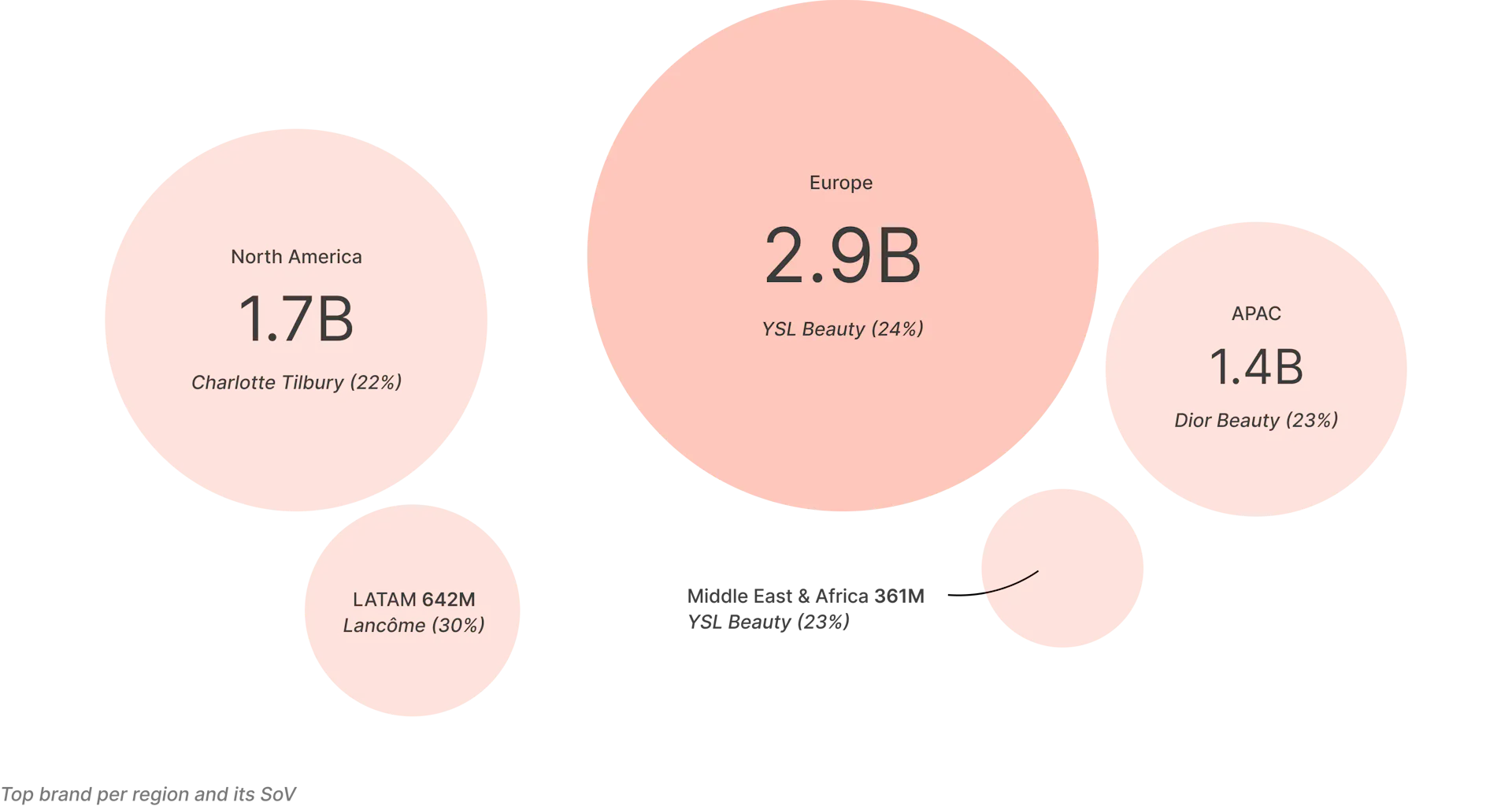
In terms of products, makeup generated 31% of total luxury visibility, heavily dominated by lip products, followed by blush and foundation. Across most subcategories, the top visible brands: YSL Beauty, Dior Beauty, Lancôme, Charlotte Tilbury, and Armani Beauty, dominated visibility, accounting for an average of 86% of the total visibility.
Masstige: The Biggest Beauty Category Got Louder
Masstige reached $8.4B in total EMV, up 11% YoY. Market activity expanded further, with post volume surpassing 1M posts, up 45% YoY. Interestingly, this wasn't driven by new creators, but by existing creators posting more frequently.
TikTok solidified its absolute dominance here, expanding its share of voice to 61%, while Instagram’s contracted to 35%. Aesthetics centered around skin-minimalism, while microtrends like "butter skin" and the preparatory ritual hashtag #MorningShed dominated feeds.
Huda Beauty was the leading brand across the entire beauty industry in 2025. It rested on a structural advantage: the largest creator ecosystem, an engagement rate 10x the market average, and a founder, Huda Kattan, whose personal account drove an incredible $34M in EMV directly.
APAC Brands: Two Distinct Growth Strategies
In 2025, APAC beauty brands took two very different paths to growth. While K-Beauty expanded aggressively onto the global stage, C-Beauty doubled down on strengthening its domestic leadership.
K-Beauty scaled through global relevance
K-Beauty's international momentum was fueled by a combination of cross-market celebrity partnerships, TikTok Shop, and highly shareable skincare trends. Rather than relying solely on Korean audiences, brands successfully built visibility across North America and Europe by pairing social commerce with viral aesthetics such as "glass skin", that generated $386M in total visibility. At the same time, ingredient-led innovation like PDRN—an ingredient extracted from salmon reproductive cells and traditionally used for post-procedure skin repair—helped reinforce the category's reputation for delivering cutting-edge skincare.
C-Beauty reinforced its home-market advantage
In contrast, C-Beauty prioritized deepening its position in China, generating $562M in EMV on Weibo. Growth was driven by expansive celebrity ambassador programs and a strong emphasis on scientific credibility, with brands building campaigns around proprietary ingredients, dermatological expertise, and trend-led skincare routines.
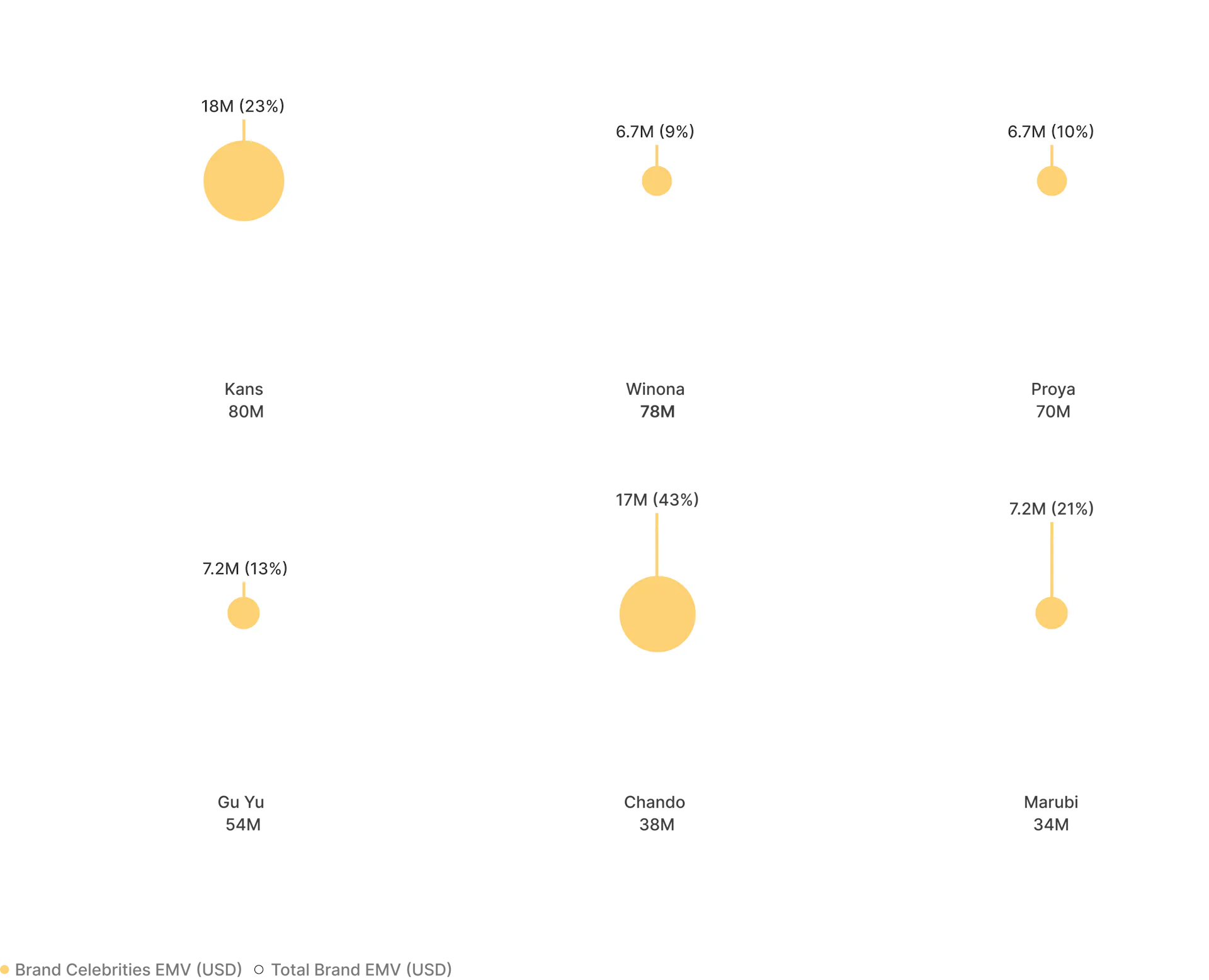
Discover the Top Beauty Brands Shaping APAC
Discover the top APAC brands by EMV and their year-over-year performance.
Download ReportWellness & Supplements: One Market, Two Playbooks
Wellness and Fitness segment exploded by 45% YoY, but the category diverged into two very different playbooks. Fitness thrived on community and identity, with micro-creators documenting authentic training journeys and building engaged, organic communities. In contrast, Supplements became increasingly transaction-driven, relying on mega-influencers, affiliate programs, and TikTok Shop to maximize conversions through highly promotional content.
 MyProtein. (Instagram)
Derma Brands: Scientific Credibility Meets Entertainment
The derma category reached $6.1B in EMV, overwhelmingly fueled by TikTok. But the structural shift here was that clinical authority was replaced by entertainment-led growth.
Dermatologists, once the dominant voices, were overtaken by creators who integrated skincare naturally into their daily routines, making products feel more relatable and accessible. At the same time, consumers increasingly engaged with skincare through desired outcomes—such as brighter, clearer, or more hydrated skin generated $2.4B in EMV, rather than ingredients, reflecting a more benefit-led approach to discovery.
 Erborian. (Instagram)
Sunscreen also evolved beyond a seasonal category, with conversations beginning much earlier in the year as consumers researched and purchased proactively. It grew 57% YoY to $742M EMV, with Q1 2025 experiencing a 278% explosion as consumers moved their research and purchasing forward by a full season. La Roche-Posay completely dominated this space, owning 56% of the category total.
Niche Fragrance & Beauty Tech: The Fragmented Market
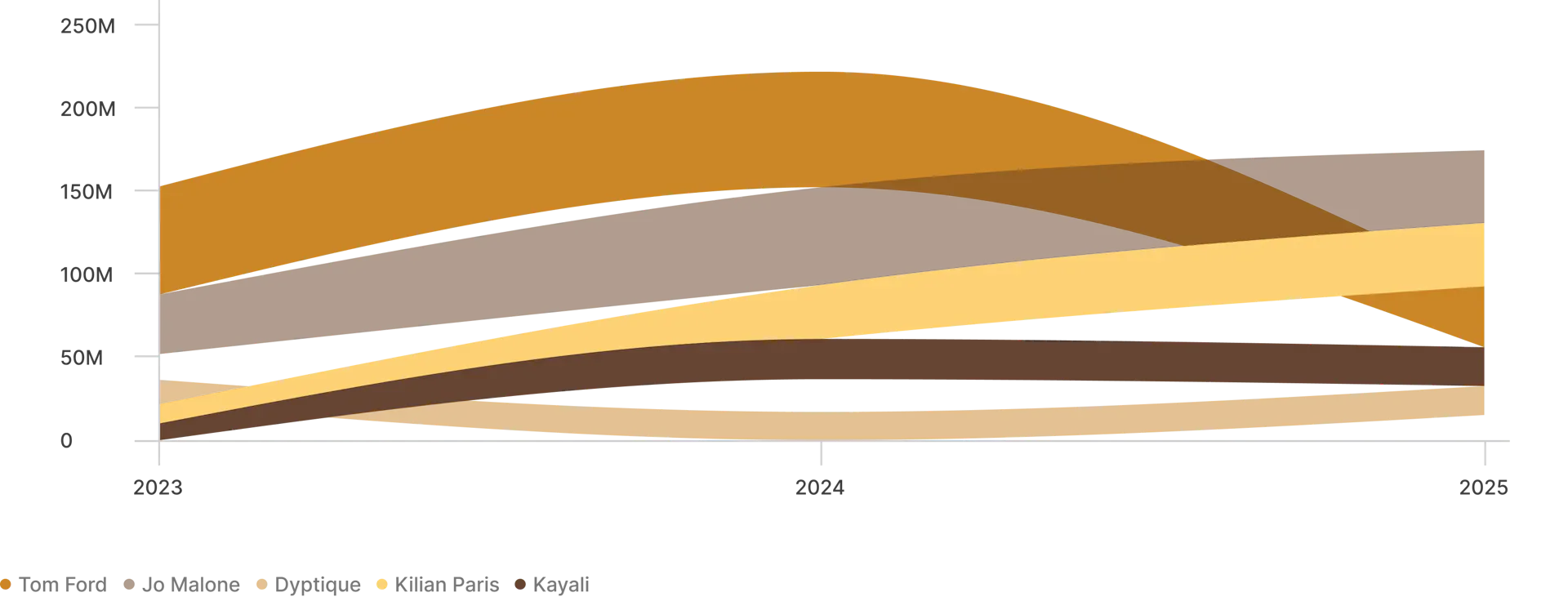
After its explosive growth in 2024, Niche Fragrance entered a more mature phase as consumers shifted from viral unboxing content to building personal scent identities through fragrance layering and signature scent recommendations. Legacy leader Tom Ford Fragrance saw its market share fall from 30% in 2023 to 13% in 2025, paving the way for a more competitive, fragmented market where Kayali rose to a 14% share of voice.
Beauty Tech saw mixed momentum in 2025. Traditional hair tool brands such as Dyson and GHD lost pace as newer challengers like Shark Beauty gained traction, while beauty devices surged on the back of viral hero products. The category increasingly rewarded brands that could create sustained social buzz around a single breakthrough innovation rather than relying on established brand equity.
What This Means for 2026
The three forces that defined beauty in 2025—TikTok's dominance, the redistribution of authority, and the compounding value of community—are not going away any time soon. The social landscape is becoming more dynamic than ever, with evolving platform algorithms and faster trend cycles challenging how beauty brands capture and retain attention. In 2026, reach alone will no longer be enough to drive sustained success. Instead, the next wave of growth will favor brands that deepen community engagement, tailor strategies to each platform, and build lasting relevance. Those that adapt early will be best positioned to outperform the market.